

The King, The War, And the Crow
A fictional story with semi-linear mechanics made in Twine
Overview
What is the king, the war, and the crow?
The King, the War, and the Crow is an interactive fictional story with semi-linear storytelling mechanics that I made in the software, Twine. The story's setting takes place in a fictional world that connects the culture of Celtic Mythology to the similar myths of the Arthurian Era and how the spread of Christianity through colonization effected pagan cultures like the Celts.
While I originally planned to write the entire story, because of time constraints, The King, the War, and the Crow is the "Act 1" of what will (eventually) be a full story.
The story of this act primarily tells a tale of the Celtic goddess, The Morrigan, and her journey through the dying Celtic Era and the beginnings of the Arthurian Era. The story is non-linear, as the beginning of the story takes place in the present, but a majority of the act is in the past, being retold as a tale through Morrigan and her husband, Caradoc, to their son, Mór.
Embedded twine HTML

The king, the war,
and the crow
Development
Research and Planning
When starting development of this project, it was important to me that I try to portray Celtic and Arthurian Mythology in a cohesive and faithful manner. The only way for me to do that was to extensively research the topics and combine elements to create a comprehensive fictional story.
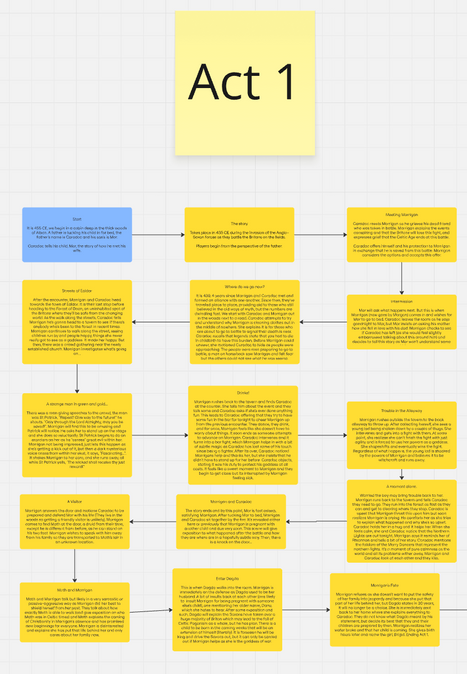
When researching, I essentially compiled a whole plethora of different sources off Google searches, mainly comprising of articles. Using the sources, I used the website, Miro, to plan an overview of what the story would be and each story beat for Act I, II, and III.
Miro Planning overview
Click image to view in Miro!

A little setback...
As I was planning to write the story, I soon realized while planning Act 1, that I was unable to write the FULL story in time for the project's submission.

Below is the evidence of this revelation...
Mitigation:
It was around this point when I had to present a "status update" to the class on my project and the progress I had made. This presentation is what got me to scope down the project in terms of content and workload for me to write, since I realized that I still had a lot of work to do and hadn't planned everything yet.
With this in mind, I filled out Act 1 to have more story beats and distinct sections where the perspective changes from Morrigan to Caradoc and vice versa.
Twine Implementation
Once Act 1 was roughly planned out, I began working in Twine by writing an interactive story with semi-linear storytelling mechanics. These mechanics primarily consisted of giving the audience limited choices that would slightly branch the outcome, but return back to the main flow of the story. I mainly did this to provide an amount of agency to the audience when interacting with the experience.
Below are examples of this semi-linear storytelling:


As you can see, the branch doesn't greatly impact the outcome of the story, but at least provides agency for the audience when reading through it.
Lots and lots of writing...
Once I started writing the project in Twine, I wrote and I wrote for the next 4-5 days, straight.
Below is the visual length of the story and how many branches I made:

The main reason I spent so much time writing for the story was because I had planned a large amount of story content to cover. I also realized that making a story in Twine would increase the amount of time it would take write because it's interactive and requires a cohesive step-by-step process of storytelling.
This meant I had to write in a first-person perspective and have the characters interact with the world while ALSO giving the audience the agency to interact.
Therefore, each part of the story became longer to get through since I was writing a lot of content per branch. In fact, when I timed myself going through the story, it took about 40 minutes to conventionally read through everything.
Adding Immersion
One of the most important aspects for me when using Twine, was that I try and utilize some of its capabilities to immerse the audience into the story.
I did so by using tools like importing images into the HTML so they helped provide a visual representation of what was happening.

Another technique was to change the text's color to make the characters speaking more distinct, and also animate certain words to emphasize the moment.

However, the number one immersion technique I used was music. Every part of the story has some kind of music track playing in the background to allow the audience to fully envelop themselves in the story. Besides a few select songs, majority of the music tracks from The Elder Scrolls V: Skyrim (Original Game Soundtrack).

While I believe embedding music is possible in Twine, my knowledge of that capability was limited so I instead added a link that took the audience to a YouTube version of the tracks, playing while they read.
Reflection
Looking back...
As of writing this reflection, it's been about 2 years since I planned and wrote this project for my English class. Looking back at it, there are a couple aspects I would change or add on to it if I could:
Write a linear story:
I think if I really think about it, the main aspect that made this project longer than it probably needed to be was that I wrote it in Twine. Since I was writing an interactive story, it made sense to me to create some branches for the sake of giving the audience some agency when reading through it.
However, branching meant doubling the amount of writing it normally took to write one node since I needed to make an outcome for either choice, and how it led back to the original path. It also didn't help since I had to write the project in a short timeframe.
If I went back and continued this story, I would very likely just write a linear, non-interactive story that would be equivalent to reading a book. Writing a branching narrative is no longer a focus of mine, so I'd likely rewrite this Act and then add the 2nd and 3rd Acts later.
Finish 2nd and 3rd act:
Speaking of 2nd and 3rd Acts, the other major addition I would add for this project is the rest of the story that I didn't get around to writing. As mentioned before, this project originally aimed to be a 3-Act Structure story, but due to over-scoping and time constraints, it was clear that writing every Act would be too large a feat before submission.
That said, now that I am no longer under a time constraint in relation to a class submission, if I found the time and motivation, I would want to continue the story I began here, as it brought me a lot of joy to work on! I'd likely have to revise the original Act so it's more linear and flows better, but it's still a story I'd like to see all the way through (eventually).